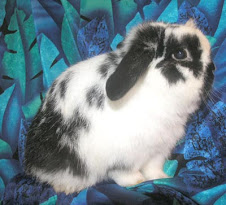
Denim had 5...no, 6....no, 7 babies yesterday. She's a grand champion broken black with a smooth body and we bred her to Kay Miller's Jason, who has a great head and nice bone. (He's a grand champion, too.) If we can get a bunch of babies from this cross, and if they're as nice as we're hoping....
Well, a lot of "if's" but that's the nature of breeding rabbits. The hope of the new match, the plans for the future matings.
We'd love to get a black out of this mating to use in our otter program. Of course, we'd love to get a batch of Best of Breed bunnies, too!
This is a nice linebreeding, with enough outcrossing to hopefully strength Denim's head while shortening her body. We'll see if the idea worked.
Showing posts with label kindling. Show all posts
Showing posts with label kindling. Show all posts
Wednesday, July 29, 2009


Monday, July 6, 2009
The big switcheroo
You may need a list of players for this story, but we need to talk about fostering. So here goes.
First, my does surprised me with one of the first 4 for 4 deliveries I've ever seen. Four does were due over the weekend,including a first timer. When working with Hollands, we've gotten used to all sorts of complications. New mamas sometimes have storms of the brain (as opposed to brainstorming) and have all their babies on the wire. Or the babies are born dead in the box. Or the mama stomps them in her in-and-out dance with the nest box.
But this time, we have four mothers and four litters. One mama had two but one was DOA (dead on arrival) and so we're back to the single litter. That makes no sense and I will foster that single baby into another litter. (In fact, that's why I like to kindle in groups, to make fostering at least a possibility.)
But here's where things get complicated. I have a buck on loan for a couple of weeks and, of the four does who just delivered, Ribbon is the one I'd most like to breed to this buck while he's here.
Ribbon has 3 babies in her litter. But I plan to foster those babies, one at a time, over to Tinsel, who only has one baby. So Tinsel will be raising 3 babies which are not her own. That will free up Ribbon for a breeding to Jazbo, the visiting buck.
Fostering isn't hard. I usually only transfer one baby a day into the new nest, but I've never had a doe even sniff twice. She usually hops into the nest box, feeds whoever is in there, and is then off duty for several hours. The reason I transfer one at a time is to give her a chance to increase her milk supply a little more slowly than going from one baby to four.
The other complication is keeping track of whose baby is whose. I prefer to foster where the color of the fostered baby is different from the original litter. And I keep good written records.
The challenge today is that Tinsel and Ribbon both have tort babies. So I may try to tattoo a little line into the ear of Tinsel's baby. At this size, that's a challenge.
Or I may (hang onto your hat here) foster Tinsel's tort single into Knock Out's litter, which is totally otter and blacks. Tinsel's tort would be easy to find in that litter but it does seem odd to make Tinsel raise somebody else's babies while forcing another mama to raise hers.
Welcome to the world of fostering.
Thursday, June 4, 2009
Babies coming slowly
We're waiting out a first-time doe this evening. She was due to deliver today and had a single on the wire this morning, dead on arrival. Although the doe seemed pretty calm as though she were finished, we palpated her. Sure enough, there was at least one more undelivered.
So we waited.
Does can go late and we don't generally bother one until she's at least 3 days past her due date. (This assumes that I am very sure about the breeding date.) At 3-4 days, if nothing has happened, we palpate her again. Once in a while, she's re-absorbed babies.
If she is pregnant, we will then re-breed her to a buck. Often that stimulation from the breeding will induce labor. If that hasn't worked by the next day, we will try oxytocin. Now we're not veterinarians and we're not recommending this, because we can't. I'm just telling you what we do.
We give 0.2 cc oxytocin subcutaneously. Usually the first dose starts labor but we are willing to give a second dose a half hour after the first dose. We stay with the doe for at least an hour when we do this because she will invariably deliver babies on the wire. We have to be there to have any chance of saving babies born on the wire.
But we're not expecting live babies at this point. Our goal is to get the babies delivered. A retained baby can poison the mother or, if somehow mummified, prevent future pregnancies.
Others massage the mother's tummy to stimulate labor or use different herbs or natural treatments. Those are good ideas but we're not experts on those. If you use any, would you post those here? I'm always looking for new ideas.
Tuesday, May 26, 2009
Nest box management

The way does prepare their nest boxes for an incoming litter makes me laugh at times. In the photo above is a nest box that's been worked over while the doe is waiting out the last few days before babies come. We put a layer of wood chips and a nice bed of grass hay in the box but most does, like the one above, have to do their own nest-building.
Some does are a nervous wreck until they get the box in their cage. Then they build a nest immediately, burrowing into the hay and sometimes even pulling some fur. The burrow into the hay confirms that the doe is indeed bred. Sometimes they burrow in and then, a day later, tear it apart. You never know what pregnancy hormones do to the brain.
We had a doe once who, when the box was delivered to her cage, promptly tore the bedding to shreds. She threw out every bit of hay and wood chips. If we put more in, she tossed that, too. But the morning she was due, she pulled copious amounts of fur and then delivered immediately. See what I mean about hormones and brain activity?
So I don't pay much attention to the pre-birth nest. But the post-birth nest box interests me a lot. Here's the kind of nest I love to see when I check on the new mama and babies:
 What I like to see is a nice fluffy pillow of fur with new babies nicely tucked in underneath. I've tried to duplicate that with newly-pulled fur but I can't do it. When a mama had healthy babies in the box and she's going to take good care of them, I see a nice fluffy nest.
Here's a nest after a doe lost her babies.
 Instead of being light and fluffy, this nest is tromped down. Only rarely are there living babies in a nest like this, although I've sometimes found newborns alive in the fur. What usually happens is that the doe will, within 24 hours, build a nice fluffy nest like the first one pictured if there are living babies in the nest. If no babies survived, the nest is more like a shelled-out hollow of flat fur and grass.
Subscribe to:
Posts (Atom)



 Posts

